
Why Young People Still Need Coding in the Age of AI?
By Dr Jingrong Tong (August 9, 2026)
I am not a coder. But as a computational social scientist, I code every day.
I use coding in my research, teaching and even administrative work. It helps me find insights in data and complete tasks more quickly and efficiently. Over the past two years, I have also started using AI to support my coding. I no longer need to write every line of code from scratch, which saves me a great deal of time.
However, I am still teaching my son Python and encouraging him to continue learning how to code.
He started learning Python with me when he was ten years old. After only three months, he took part in a Bebras coding competition designed for 14/15-year-olds and received a Merit award. He has continued learning Python, and I would now describe his skills as intermediate.
Both my husband, who is a computer scientist, and I are encouraging him to learn more advanced Python concepts before moving on to another programming language. Yet he does not want to become a professional coder — and neither of us expects him to.
So, how does my personal experience sound to you? Does it make you wonder: why do children still need to learn coding when AI can do the job for us?
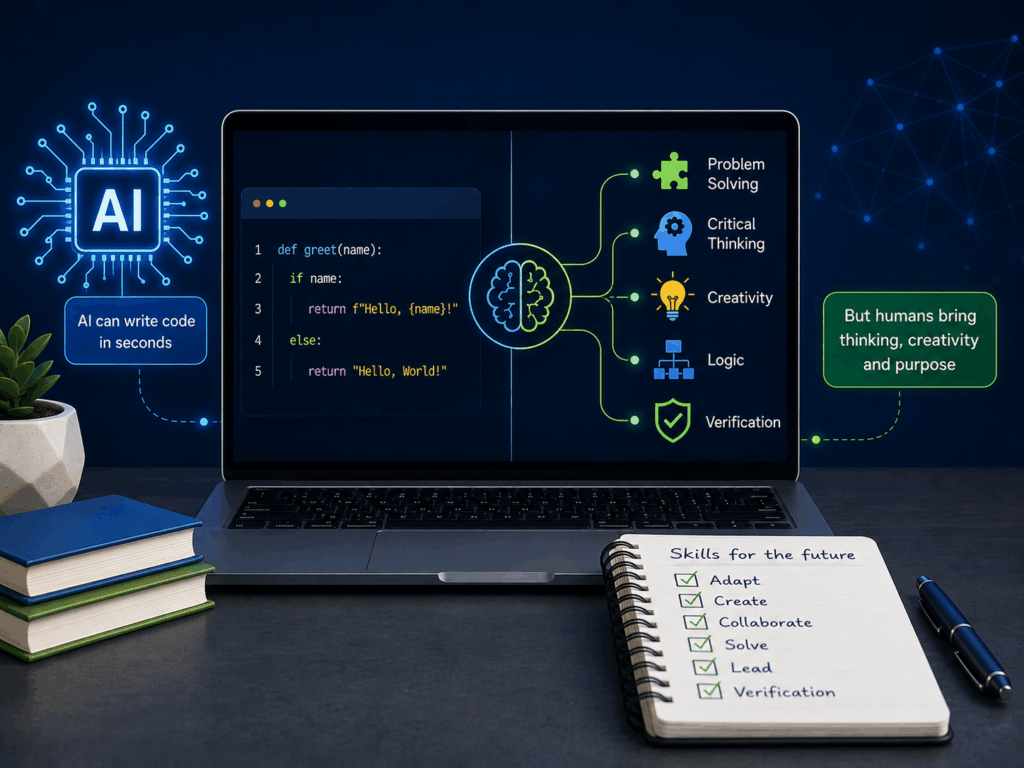
It is a reasonable question. Generative AI can already write code, saving us a significant amount of time and changing the nature of many programming jobs, particularly entry-level roles. However, I believe there are at least three important reasons why children should still learn coding if they are to make the best use of AI.
- They need to understand and validate AI-generated code
To use AI-generated code effectively, you need enough coding knowledge to check whether the output is accurate, reliable and suitable for the problem you are trying to solve.
AI does not always produce the correct answer. Even when the code works, it may not fully match your particular needs. In many cases, you will need to revise, debug or adapt it to your specific use case.
Without a basic understanding of coding, it is difficult to recognise mistakes or judge whether the solution is genuinely useful.
2. Effective prompts require logical thinking and problem-solving skills that coding can help children develop
Writing an effective prompt is not simply a matter of asking AI a question. To get a useful result, you need to define the problem clearly, provide the right context and explain the task in a logical, structured way.
This is where coding can help. Learning to code is not only about memorising syntax. It teaches children how to break a complex problem into smaller steps, identify patterns, test possible solutions and refine their approach when something does not work.
These skills are especially important when using AI for complex or large-scale tasks, where a simple prompt is rarely enough. You need to be able to guide AI step by step, evaluate its responses and adjust their instructions until they reach a suitable solution.
By learning to code, children can develop the logical thinking and problem-solving skills needed to communicate with AI more effectively.
3. AI-generated code cannot replace children’s creativity, curiosity and purpose.
Generative AI creates content by identifying patterns in existing data. It can produce impressive results and suggest useful solutions, but it does not have a child’s curiosity, personal experience, imagination or sense of purpose.
AI can help you explore possible answers, but it cannot decide which problems are worth solving or what they should create. Those choices still come from human interests, values and creativity.
When children understand coding, they are not limited to accepting whatever an AI tool produces. They can question its suggestions, experiment with different approaches, develop their own ideas and use technology to create something original and meaningful.
Final thoughts
Without sufficient coding knowledge, people may struggle to communicate effectively with AI, evaluate its output or ask it to complete a task in the way they actually need.
Children also need some understanding of how AI works so that they can prompt it thoughtfully and validate what it produces.
AI can provide the syntax, but it cannot replace a child’s problem-solving skills, critical thinking, judgement or creativity.
That is why I continue teaching my son to code — not because I expect him to become a programmer, but because I want him to become someone who can think clearly, solve problems and use AI confidently rather than depend on it blindly.
© 2026 Uni-Beacon. All rights reserved.